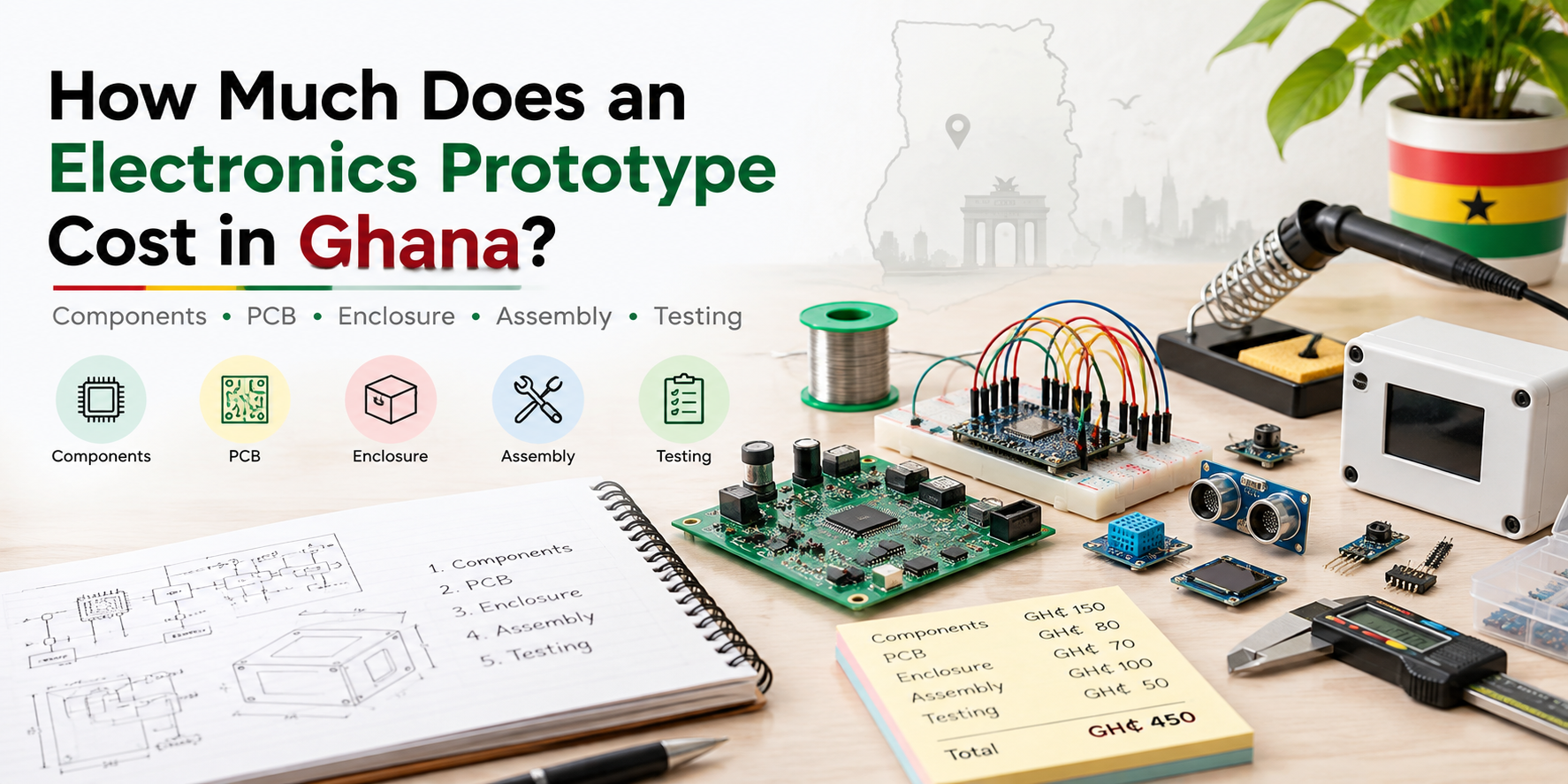
There is no responsible fixed price for “an electronics prototype” without a scope. A breadboard demonstration may require a few standard modules and days of work; a battery-powered connected product with a custom PCB, enclosure, firmware, cloud service and field testing can require several revisions and months. The useful question is: what evidence must this prototype produce, and what work is required to produce it?
The main cost categories
Problem and requirements: user research, specification, architecture and risk reduction.
Engineering time: electronics, firmware, mechanical design, application or cloud work, documentation and project management.
Components: development boards, sensors, connectors, batteries, custom parts and spares.
PCB: schematic, layout, fabrication, assembly, stencils, setup, shipping and taxes.
Mechanical work: CAD, 3D printing, machining, hardware and finishing.
Testing: fixtures, instruments, reference equipment, field travel and repeated trials.
Revisions: replacement parts, a second PCB, firmware changes and enclosure reprints.
Prototype type changes the budget
A proof of concept answers one risky question and may look rough. A functional prototype integrates the main system. An appearance prototype tests size and user interaction. An engineering validation unit is much closer to production and needs repeatable hardware, controlled files and serious tests. Ask suppliers to name which one they are quoting.
Imported parts add more than unit price
For Ghana-based builds, exchange rates, international shipping, customs, minimum order quantities and delivery uncertainty can be significant. A one-dollar component is not a one-dollar installed component. Local availability may justify a technically less elegant but supportable choice.
Complexity multipliers
mains voltage, high current or lithium batteries;
cellular, RF or long-range wireless;
very low power or long battery life;
precision analogue measurement;
harsh outdoor environments;
medical, automotive or safety-related claims;
custom mobile apps and cloud dashboards; and
formal certification or production tooling.
How to request a useful quotation
Provide the user problem, required functions, target environment, schedule, budget range and what already exists. State the expected deliverables: source files, firmware, number of units, enclosure, test report and documentation. Separate mandatory features from later ideas.

How to reduce cost without weakening the project
Test the largest uncertainty with a focused proof of concept first.
Use modules until custom integration has a clear benefit.
Reduce the number of features and interfaces.
Choose available, documented components.
Define acceptance tests before design starts.
Reserve budget for at least one learning cycle.

Beware of the cheapest first quote
A quote that excludes source files, testing, revision support or component sourcing may cost more by the end. Compare deliverables, assumptions and ownership—not only the total. A prototype is valuable when it reduces uncertainty and leaves you with a reproducible design.
Read proof of concept vs prototype vs product before deciding what to commission. For a scoped estimate, send CircuitWise your requirements.